
 vie
vieWhen AI can retrieve information, generate content and complete complex tasks within seconds, the value of education can no longer be measured simply by how much knowledge students can remember. A more important question is whether they can verify information, ask meaningful questions, collaborate with others and use technology responsibly.

- 1 What are 21st-century skills?
- 2 Why are 21st-century skills important in the age of AI?
- 3 The 4Cs: Moving from acquiring knowledge to creating solutions
- 4 Information, Media and Technology skills: Finding information is not enough
- 5 Life and career skills: Students must learn to lead themselves before leading others
- 6 The seven General Capabilities in the Australian Curriculum
- 7 How does Nam Uc Scotch AGS develop 21st-century skills?
- 8 Preparing for the future does not mean predicting it perfectly
What are 21st-century skills?
Twenty-first-century skills are commonly organised into three broad areas:
- Learning and innovation skills
- Information, media and technology skills
- Life and career skills
Established frameworks such as the 4Cs, IMT and FLIPS help to organise these capabilities. In practice, however, they rarely operate in isolation. Consider a student completing a project on climate change. The student may need to interpret data, evaluate the reliability of sources, collaborate with team members, use technology to communicate findings and consider how a proposed solution might affect the wider community. Within one learning experience, the student is drawing upon academic knowledge, digital literacy, critical thinking, communication skills and social responsibility. For this reason, the Organisation for Economic Co-operation and Development (OECD) defines competence more broadly than a single skill. A competent learner must be able to combine knowledge, skills, attitudes and values in order to act consistently and responsibly. The OECD Learning Compass 2030 places particular emphasis on student agency: a learner’s capacity to set goals, make informed choices and contribute to shaping a better future.

Why are 21st-century skills important in the age of AI?
Technology can help people work more quickly, but it does not automatically help them think more effectively. Students today have access to an almost unlimited volume of information. At the same time, they must navigate misinformation, manipulative content, algorithmic bias and the risk of becoming dependent on ready-made answers. Therefore, digital literacy must extend beyond the ability to operate devices or use software. Students need to understand when technology is appropriate, how to evaluate AI-generated outputs and what responsibilities accompany its use.
UNESCO’s AI Competency Framework for Students similarly highlights the need to prepare learners to become responsible users and co-creators of AI, rather than passive consumers of technology. In this environment, a student’s long-term advantage does not come from competing with machines in speed or processing power. It comes from distinctly human capabilities: interpreting context, generating original ideas, understanding other people, considering ethical implications and accepting responsibility for decisions.

The 4Cs: Moving from acquiring knowledge to creating solutions
The 4Cs represent four closely connected learning and innovation skills:
- Critical thinking enables students to question the source, evidence and logic behind information before reaching a conclusion.
- Creativity allows them to connect seemingly unrelated ideas and explore new approaches.
- Communication helps students express complex ideas clearly, logically and in a way that is appropriate for their audience.
- Collaboration teaches learners to listen, share responsibility, navigate differences and remain collectively accountable for outcomes.

Together, these capabilities help students move from simply “knowing” to being able to apply what they know. The 4Cs cannot be developed merely by reading definitions or memorising techniques. Students need opportunities to practise them through open-ended problems, interdisciplinary projects, discussion, research and constructive feedback. When learners are allowed to experiment, make mistakes and refine their thinking, they gradually recognise that education is not always about finding a single predetermined answer. It is also about understanding a problem, considering alternatives and developing a reasoned response.
Information, Media and Technology skills: Finding information is not enough
In a digital environment, access to information is no longer the greatest challenge. The more demanding task is distinguishing between what is trustworthy, what lacks evidence and what has been designed to influence the reader’s perceptions.
- Information literacy helps students identify what they need to know, search strategically, compare multiple sources and acknowledge evidence correctly.
- Media literacy enables them to recognise the purpose, perspective and persuasive techniques behind a piece of content.
- Digital literacy allows learners to use technology for research, collaboration and creation while understanding privacy, online safety, copyright and their digital footprint.
A digitally capable student does not need to master every available platform or application. What matters more is the ability to select an appropriate tool, learn how to use unfamiliar technology and avoid handing the entire thinking process over to a machine.

Life and career skills: Students must learn to lead themselves before leading others
Success in education and employment also depends on a student’s capacity to adapt, take initiative, organise work, build relationships and lead themselves. These capabilities are commonly represented by the FLIPS framework:
- Flexibility: helps students adjust their approach when circumstances or expectations change.
- Initiative: encourages them to identify a need or problem and take appropriate action rather than always waiting for instructions.
- Productivity: does not mean completing as many tasks as possible. It involves setting priorities, managing time and producing work that has a clear purpose.
- Leadership: begins with accepting responsibility, creating a positive influence and enabling others to make progress.
- Social skills: help students understand emotions, respect differences and build healthy relationships.

These capabilities are particularly important for students preparing to study abroad. They are not simply entering a new academic programme; they must also adapt to a different culture, unfamiliar learning practices and a significantly greater level of independence.
The seven General Capabilities in the Australian Curriculum
The Australian Curriculum does not treat 21st-century skills as a collection of stand-alone subjects. Instead, its General Capabilities are developed through different learning areas and applied in relevant contexts.
Version 9.0 of the Australian Curriculum identifies seven General Capabilities:
- Literacy
- Numeracy
- Critical and Creative Thinking
- Digital Literacy
- Personal and Social Capability
- Ethical Understanding
- Intercultural Understanding
Literacy and numeracy are not regarded only as basic functional skills. Students need to read critically, construct evidence-based arguments, interpret data and use quantitative reasoning to solve problems. Similarly, digital literacy must operate alongside critical thinking. Intercultural understanding should be connected to meaningful communication and collaboration, while ethical understanding enables learners to consider how their decisions may affect other people and communities.
Together, these capabilities help students connect academic knowledge with the demands of everyday life, further education and an increasingly complex global society.

How does Nam Uc Scotch AGS develop 21st-century skills?
At Nam Uc Scotch AGS, the seven General Capabilities of the Australian Curriculum are integrated into everyday learning rather than taught as a series of disconnected skills lessons.
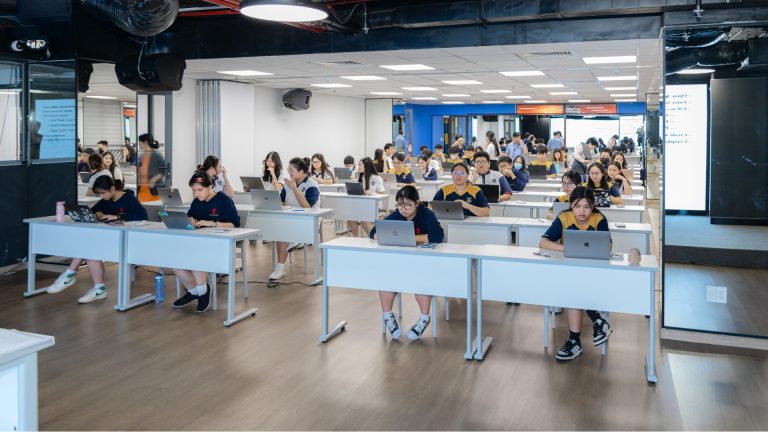
Students have opportunities to apply their knowledge through projects, discussions, research, presentations and collaborative activities that address real-world issues. During a project, for example, students may be required to analyse data, evaluate sources, propose a solution and defend their reasoning. When working in teams, they learn how to distribute responsibilities, respond to feedback and resolve differences constructively. When using technology, students do more than create a final product. They are also guided to consider the reliability of information, copyright, digital safety and their responsibilities as technology users. This approach allows knowledge and capability to develop together. Students do not practise critical thinking without a sound academic foundation, nor do they accumulate knowledge without learning how to apply it beyond the classroom.

Preparing for the future does not mean predicting it perfectly
No one can know with certainty which professions will emerge or disappear over the next 10 or 20 years. Education cannot therefore focus solely on preparing students for one fixed occupation. A more sustainable form of preparation is to equip young people with strong academic foundations, the ability to learn continuously, the confidence to work with others, the judgement to use technology responsibly and the capacity to make decisions guided by values. With these foundations, students are not merely prepared to adapt to the future. They have the confidence, competence and sense of responsibility needed to help shape the future in which they want to live.