
 vie
vieResearch skills are the abilities needed to formulate questions, plan an investigation, locate and evaluate sources, collect or analyse evidence, synthesise findings and communicate conclusions responsibly. Schools can develop these skills in every student through explicit teaching, teacher modelling, appropriate scaffolding, flexible ways of accessing and presenting information, regular reflection and assessment of both the research process and the final product.
- 1 What are research skills?
- 2 Why should every student develop research skills?
- 3 8 ways to develop research skills in every student
- 3.1 1. Begin with a question that matters to the learner
- 3.2 2. Model the thinking process instead of simply asking students to research
- 3.3 3. Provide scaffolding and gradually reduce it
- 3.4 4. Teach students to evaluate sources within context
- 3.5 5. Allow different ways to investigate and communicate findings
- 4 6. Make metacognition part of the research process
- 5 7. Build a community of inquiry while maintaining individual responsibility
- 6 8. Assess the process, not only the final product
- 7 What is needed to make research accessible to every student?
- 8 The ultimate goal – Helping students learn how to keep learning
When given a research topic, some students immediately open dozens of websites but do not know which sources to trust. Others struggle to formulate a suitable research question. Some may understand the topic but find it difficult to read lengthy materials or communicate their findings through an academic paper. These challenges are often mistaken for a lack of initiative or an absence of “research ability”. Research skills, however, are not an innate talent reserved for a small group of high-achieving students. They are a combination of capabilities that can be taught, practised and developed over time. When research tasks are designed appropriately, every student can make progress from their own starting point. Research skills are not an innate talent reserved for high-achieving students. They can be taught, practised and developed over time.

What are research skills?
Research skills refer to the ability to formulate questions, locate and evaluate information, collect or analyse evidence, connect findings, draw conclusions and communicate results clearly and ethically.
The Association of College and Research Libraries (ACRL) describes research as an iterative process of inquiry. An initial answer may lead to further questions, while newly discovered information may require students to revise their keywords, broaden their perspective or reconsider their hypothesis. Therefore, research is not a straight path from a question to an answer. Nor is it simply a matter of searching on Google or using AI tools and formatting citations correctly. A complete research process generally involves six interconnected capabilities:
| Component | What do students need to do? |
| Asking questions | Identify what they want to investigate and narrow the scope appropriately |
| Planning | Select suitable methods, sources, tools and timelines |
| Searching or collecting information | Use keywords, databases, observations, surveys, interviews or experiments |
| Evaluating and analysing | Examine the reliability, relevance, methodology and quality of the evidence |
| Synthesising and concluding | Connect findings and identify contradictions, gaps and limitations |
| Communicating and reflecting | Cite sources, communicate findings, respond to feedback and review the process |
Behind these practical steps are several important dispositions: curiosity, perseverance, openness to different perspectives, honesty when using sources and a willingness to revise conclusions when stronger evidence emerges.

Why should every student develop research skills?
Research is not only for older students or those with strong academic results. From primary school, children can begin developing research skills by observing, asking questions and looking for explanations of familiar phenomena. As students progress through school, their methods and standards of evidence become more sophisticated. However, the underlying cycle remains the same: Question -> investigate -> verify -> connect -> communicate -> refine
The Australian Curriculum Version 9.0 identifies inquiring, generating ideas, analysing and reflecting as central elements of Critical and Creative Thinking. This means students are expected not only to receive knowledge but also to ask questions, evaluate information, develop ideas and adjust their thinking in response to what they have learnt. Research should therefore not be confined to a single subject. Students can conduct research in Science, History, Literature, the Arts, Business or through an issue connected to their local community.
Importantly, “every student” does not mean that all students must complete the same task in exactly the same way. Educational equity involves maintaining meaningful academic expectations while providing different forms of support so that each learner can overcome barriers and work towards shared outcomes.

8 ways to develop research skills in every student
1. Begin with a question that matters to the learner
A topic that is too broad can leave students unsure where to begin. Yet a completely prescribed topic may reduce curiosity and motivation. Teachers can provide a shared framework while allowing students to choose a problem, group or perspective that connects with their interests.
Instead of asking the entire class to investigate “environmental pollution”, for example, students might explore air quality around the school, food waste in the canteen or their families’ use of single-use plastics. Choice does not reduce academic rigour. It helps students understand why the question is worth investigating.
2. Model the thinking process instead of simply asking students to research
“Research this topic independently” is not yet a complete instruction. Teachers need to break the process into visible, practicable steps: narrowing a question, developing keywords, identifying different source types, taking notes, comparing evidence and citing information.
One effective strategy is a think-aloud, in which the teacher verbalises the thinking behind each decision. For example, the teacher might open two sources, explain why one appears useful, question the reliability of the other and demonstrate how to revise a keyword when the search results are unsuitable. This allows students to observe decisions that often take place silently in the mind of an experienced researcher.

3. Provide scaffolding and gradually reduce it
Students who are new to research may need sample questions, keyword lists, source-evaluation checklists, note-taking templates or timelines divided into manageable stages. However, these supports should not become permanent worksheets that students simply complete without thinking.
Teachers can move gradually from modelling to guided practices, collaborative practices and, eventually, independent research. Guidance from the Education Endowment Foundation highlights the value of explicitly teaching metacognitive strategies, modelling them, providing appropriate scaffolding and gradually transferring responsibility to students. This is particularly valuable for learners who have not yet developed effective independent learning strategies.
4. Teach students to evaluate sources within context
Students should not be taught that one type of source is always reliable while another is always unsuitable. The value of a source depends on the research question and the purpose for which it is being used.
A peer-reviewed article may be appropriate when examining experimental findings. Government data may be useful for analysing population trends, while an interview with a witness can reveal experiences that statistics do not capture. Students can learn to ask:
- Who created this source?
- What was its purpose?
- How was the evidence collected?
- Is the information still current?
- Does it relate directly to my research question?
They should then compare two or three sources to identify areas of agreement, difference and uncertainty.
5. Allow different ways to investigate and communicate findings
The CAST Universal Design for Learning Guidelines recognise the natural differences among learners and recommend offering multiple ways to engage, access information and demonstrate learning. In a research project, students might work with written materials, images, datasets, videos, interviews, observations or experiments. They could communicate their findings through a report, poster, podcast, presentation or visual product. Flexibility in format does not mean lowering academic standards. Regardless of the medium, students should still meet shared expectations:
- A clearly defined question
- Relevant and reliable sources
- Appropriate evidence
- Logical reasoning
- Transparent citation
- A conclusion that acknowledges limitations
6. Make metacognition part of the research process
Effective researchers do not only understand what they have discovered; they also recognise how they are learning. A short research journal can help students reflect on three stages:
- Planning: What do I already know? What do I need to investigate? Which strategy might work?
- Monitoring: Are my current sources answering the question? Where am I experiencing difficulty?
- Evaluating: Is there enough evidence to support my conclusion? What would I change if I repeated the project?
These questions help students manage their progress, recognise an unproductive direction early and become less dependent on teachers to remind them of every step.

7. Build a community of inquiry while maintaining individual responsibility
Research does not need to be a solitary activity. Group discussions, peer feedback and small research conferences can expose students to different perspectives and help them practise asking questions and explaining their choices. However, group projects can sometimes conceal uneven participation. Alongside the shared outcome, each student should provide evidence of their contribution, such as a source journal, an individual analysis, a personal reflection or a short oral defence. This approach preserves the benefits of collaboration while helping teachers identify the support each student needs.

8. Assess the process, not only the final product
When grades are awarded only for the final submission, students may focus on producing something that looks polished rather than developing genuine research thinking. A balanced assessment system should recognise:
- The quality of the research question
- The research strategy
- The selection and evaluation of sources
- The use of evidence
- The response to feedback
- The honesty with which limitations are communicated
Short checkpoints – such as approving the research question, reviewing a source map, discussing the evidence or providing feedback on a draft – allow teachers to intervene at the right time. Mistakes then become information that helps students improve, rather than problems discovered only when marks are deducted from the final submission.
What is needed to make research accessible to every student?
A few isolated projects are unlikely to create lasting capability. Schools need to build a clear progression of research skills across year levels and subject areas. This progression should consider: Which types of questions are appropriate at each age; how student independence should increase over time; how expectations for source evaluation should become more sophisticated; which shared language teachers can use across subjects
Students also need equitable access to resources, devices, libraries and support time. Subject teachers, language or EAL teachers, teacher librarians and families can work together so that difficulties with reading comprehension, language or organisation are not mistaken for an absence of thinking ability.

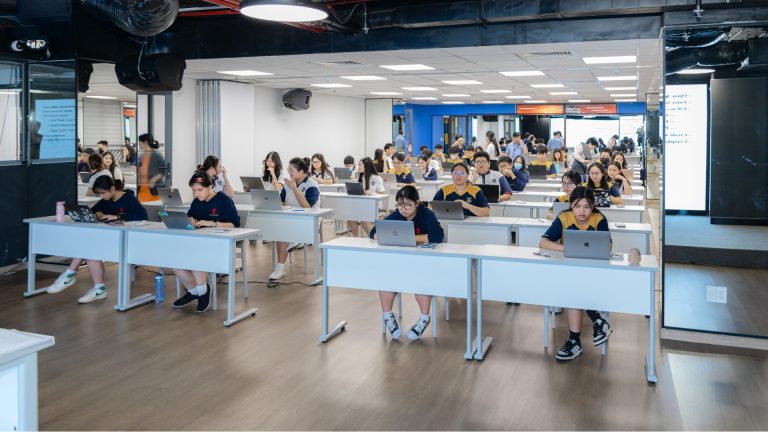
At Nam Uc Scotch AGS, research skills are not developed through one isolated subject. They are embedded in essays, inquiry activities and projects across different learning areas. Depending on their age and readiness, students are guided to formulate questions, select and evaluate sources, analyse information, communicate conclusions, receive feedback and refine their work. Teachers provide greater scaffolding during the early stages while allowing students to choose suitable topics, methods or formats. Responsibility is then gradually transferred to the learner. Within the AGS Talent (SACE) programme, this approach is further developed through Integrated Learning, which is structured around research projects across the school’s four academic streams. Students explore an area of personal significance, experiment with different strategies and reflect on their learning process. Over time, research becomes a habit of mind rather than a skill used only for an individual assignment. This approach enables research to become a habit of mind developed over time rather than a skill used only for a single assignment.
Finally, the classroom must be safe enough for students to ask questions, admit “I don’t know” and revise their conclusions. Genuine research can only take place when students understand that changing their position in response to stronger evidence is a sign of intellectual growth – not failure.
The ultimate goal – Helping students learn how to keep learning
Research skills are not intended to turn every student into a scientist. Their broader purpose is to help young people approach unfamiliar problems: ask meaningful questions, locate evidence, consider different perspectives, reach well-supported conclusions and revise their thinking when new information becomes available.

When the research process is taught explicitly, supported at the right time and practised regularly, it is no longer limited to students who are already confident or academically advantaged. It becomes a way of learning that every student can use to understand the world and gradually take ownership of their educational journey.